
Searching Hopkins County Civil Dockets
Start with the official Cases Set By Court hub. Use it if your case sits in the 8th or 62nd District Court. Each court gets its own link there. That split matters, since Hopkins County offers no single search covering every civil docket. The Easydocs pages behind those links have not returned usable results since September 3, 2026. Expect no working search fields, case-number format, filters, or document buttons until the county restores them.
The Hopkins County District Clerk is the records office to call for district civil and family files. County Court at Law cases take one extra step. The court's own page says both the District Clerk and the County Clerk keep county court records. So confirm custody before you request anything. Justice Court civil cases stay at the precinct court. Texas re:SearchTX adds a registered statewide layer. Yet the official Hopkins County file still rests with the local clerk.
- Identify the case type and court from a notice or prior filing.
- Choose the 8th, 62nd, County Court at Law, or Justice Court route.
- Search with the exact cause number or party name if the live system permits it.
- Record the court, style, setting, filing, and document title you need.
- Contact the custodian for a plain or certified copy when the docket summary is not enough.
Hopkins Civil Docket District Choices
The 8th and 62nd Judicial District Courts each have their own official county page. Both supply local court information and an online docket link. Neither page shows a private case record, though. They document the public routes a Hopkins County civil docket searcher can take. Call the clerk after that. The 8th Judicial District Court source provides court and docket routing.
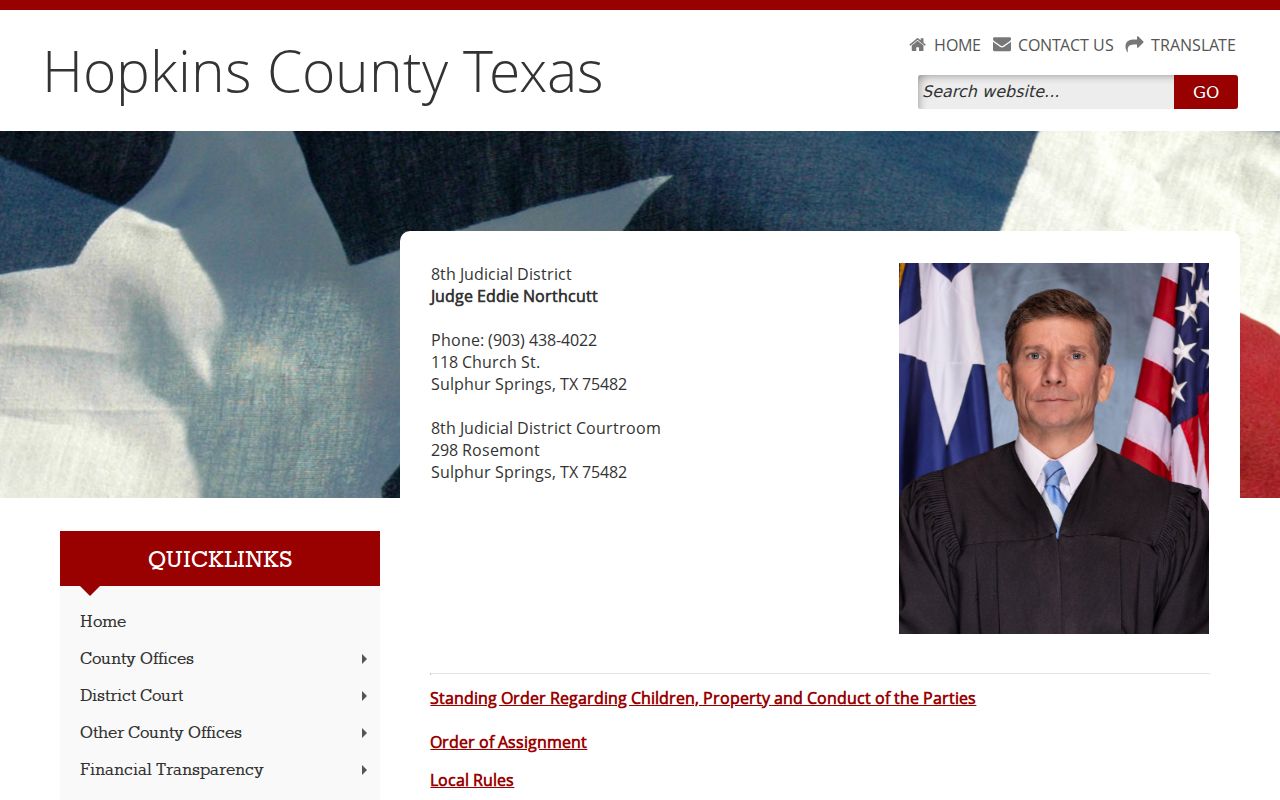
The 8th District Court's page ties the court to its county-hosted access route. When the linked docket is down, or you need a certified document, the District Clerk is still the place to call. The 62nd Judicial District Court source presents its calendar and docket route separately.
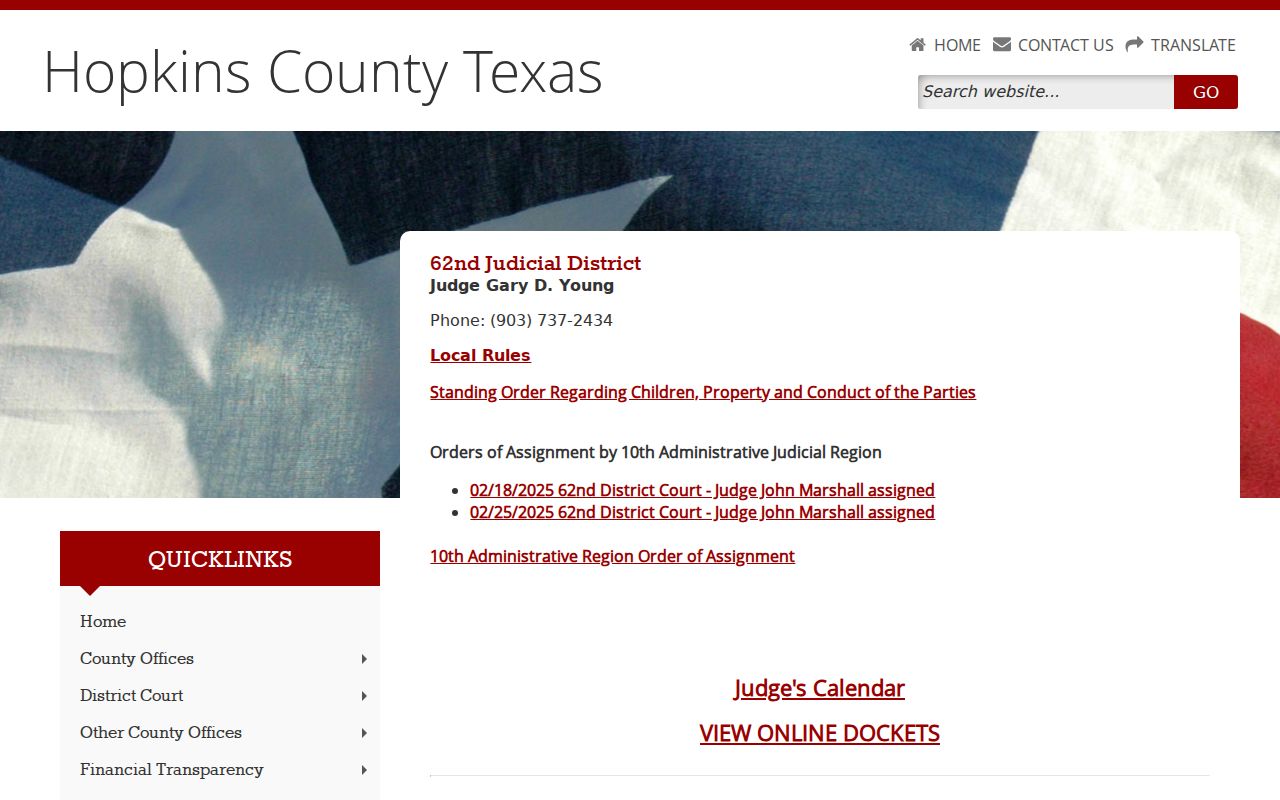
District choice is part of the lookup itself. What fields appear once the external docket link opens is another matter, and neither court page settles it.
Inside a Hopkins County Civil Docket
A civil docket records procedure in date order. It may open with a petition or application, then move through service, an answer, motions, orders, settings, judgment, and post-judgment activity. Treat these as standard docket components rather than an observed inventory of the Hopkins Easydocs views, which are not reachable. Each entry is a pointer to the official file.
| Cause number | The court-assigned identifier. No local display pattern was verified. |
|---|---|
| Style or caption | The public case title identifying parties or the case subject. |
| Service or return | Process activity where public; an absent online line is not proof of no service. |
| Motion | A request for court action, not the ruling itself. |
| Order | The court’s direction; request the signed document when its effect matters. |
| Setting | A scheduled event that may later be reset or continued. |
| Judgment | The formal disposition, distinct from a short calendar or docket summary. |
A document link may require a fee, login, clerk request, redaction, or access review. A screenshot or docket printout is not a certified judgment.
Hopkins Civil Docket Clerk Split
The Hopkins County District Clerk keeps the district-court records. The Hopkins County Clerk keeps county-clerk records and part of the county-court and probate route. The County Court at Law page expressly says both offices maintain its records. So "county court case" alone is not precise enough for a copy request.
| Lane | First contact | Why to confirm |
|---|---|---|
| District civil or family | District Clerk | 8th and 62nd courts have separate docket links |
| County Court at Law | District Clerk or County Clerk | Custody depends on the case and requested record |
| Justice Court civil | JP Precinct 1 or 2 | The precinct retains its own case record |
| Real-property record | County Clerk land-record route | A deed index is not a universal civil docket |
Give the clerk the cause number, court, case style if known, date range, and the exact item. Ask one thing too. Will the response be a docket, filed pleading, signed order, judgment, plain copy, or certified copy?
Civil Case Types on the Docket
Hopkins County civil matters span several court levels. District courts take the district civil and family cases assigned to them. The County Court at Law lists civil, family, probate, guardianship, mental-health, and assigned matters. Justice Courts hear a narrower set of civil claims under their jurisdiction. A city citation does not become a County Court at Law civil case unless a proper appeal or transfer puts it there.
- District civil disputes and related motions or orders
- Family matters, with added privacy limits for some documents
- Probate and guardianship matters routed through the proper county custodian
- Justice Court small claims and debt claims
- Justice Court eviction and repair-and-remedy cases
The official Justice Court page sets a civil jurisdiction limit of no more than $20,000. It also excludes matters like slander or defamation, title disputes, and injunction requests. Those limits keep a docket search out of the wrong court.
Civil Docket Settings and Hearings
A civil setting on a Hopkins County docket gives you a date, a time, a place, and a hearing type. Those fields appear when they are public. That is all it gives. It is not the case file itself. The Hopkins County public calendar has a Court Dockets category and export controls. Still, it may not list every case-level event. Confirm any setting that matters with the court before you act on it.
Scheduling works differently in the County Court at Law. Its local rule lets only a party schedule a hearing. The other side must be served, or must file a waiver. Only then can that hearing date hold. A civil reset form is linked on the page as well. Remember that a request to reset and an order granting the reset are two separate events. The docket history shows both.
When a date moves, search for the later order or setting. Skip the first one. The detailed Hopkins County court dates resource walks through the calendar route. It also covers the confirmation steps.
Civil Docket Access Rules
Texas Rules of Civil Procedure Rule 76a starts from a simple premise. Court records are presumed open. The same rule gives courts a process and standard for sealing. Sensitive data must be redacted under the applicable rules as well. A public Hopkins County civil docket can still show that a filing exists. But the pleading, the exhibit, or protected information may stay unavailable.
Family, guardianship, probate, protective-order, and child-related material can carry added limits. Basic metadata and the document behind it may not share the same access status. When something is withheld, ask which statute, rule, protective order, or sealing order controls. The gap is a restriction, not a missing case.
Key rules:
Texas Rules of Civil Procedure include Rule 76a’s civil sealing framework and current procedural rules.
Texas judicial open-records policy explains why judicial records are not processed as ordinary agency records.
Government Code section 552.0035 directs judiciary access to Supreme Court rules or other law.
Hopkins County publishes no official bulk API, no complete current civil fee table, and no same-day copy promise. Ask the proper clerk about format, fee, delivery method, and certification. Never rely on an estimate for any of them.
Hopkins Civil Docket Document Types
Each piece of a Hopkins County civil docket serves its own purpose. The docket entry is the chronological index. A pleading states a party's position, and a motion asks the court to act. An order records the court's direction. A judgment supplies the formal disposition. A certified copy carries the custodian's statement about the copy's accuracy.
- Filed
- Accepted into the clerk’s case file, but not necessarily granted.
- Service
- Process or notice activity recorded where public.
- Reset
- A changed event date, not a new lawsuit or dismissal.
- Trial de novo
- A new County Court at Law trial after the proper Justice Court appeal.
- Certified copy
- A copy carrying the clerk’s certification for an official need.
Request the signed item whenever legal effect matters. Give the clerk enough detail to separate the docket history from the actual document behind one line.