
Searching Hopkins County Criminal Dockets
Start your Hopkins County criminal docket search with the official Hopkins County District Court Dockets page. The clerk labels its links "Cases Set By Court." The listings split into County Court at Law, 8th District Court, and 62nd District Court. That split matters more than it looks. Pick the wrong court view and a docket search can come up empty. Yet the case record is still public. The linked Easydocs views failed to load on September 3, 2026. So no one can promise what fields or controls they display.
Have a fallback ready whenever an online view stalls. The local clerk is still the official keeper of the Hopkins County court docket. And Texas re:SearchTX offers a second, statewide case lookup once you register. One catch: state materials describe criminal case records as excluded from the current statewide collection. So treat re:SearchTX as a supplement. It does not replace the clerk's own court records.
- Identify whether the matter is a felony, misdemeanor, or Class C case.
- Open the matching court link from the county docket hub.
- Use a known cause number or case identity if the live view accepts it.
- If the portal fails, contact the proper clerk by phone, email, or at the counter.
- Ask for the docket entries, setting, or exact filed order needed.
Hopkins Criminal Docket Court Routes
Felony cases belong to the district-court lane. The Hopkins County District Clerk holds records for the 8th and 62nd Judicial District Courts. Misdemeanor criminal work runs through the Hopkins County Court at Law, whose official page also links a separate criminal docket view. Class C offenses and traffic matters may sit elsewhere entirely: Justice Court Precinct 1 or 2, Sulphur Springs Municipal Court, Cumby Municipal Court, or whichever local court is proper. The county docket hub shows the full set of court choices. View the county source.
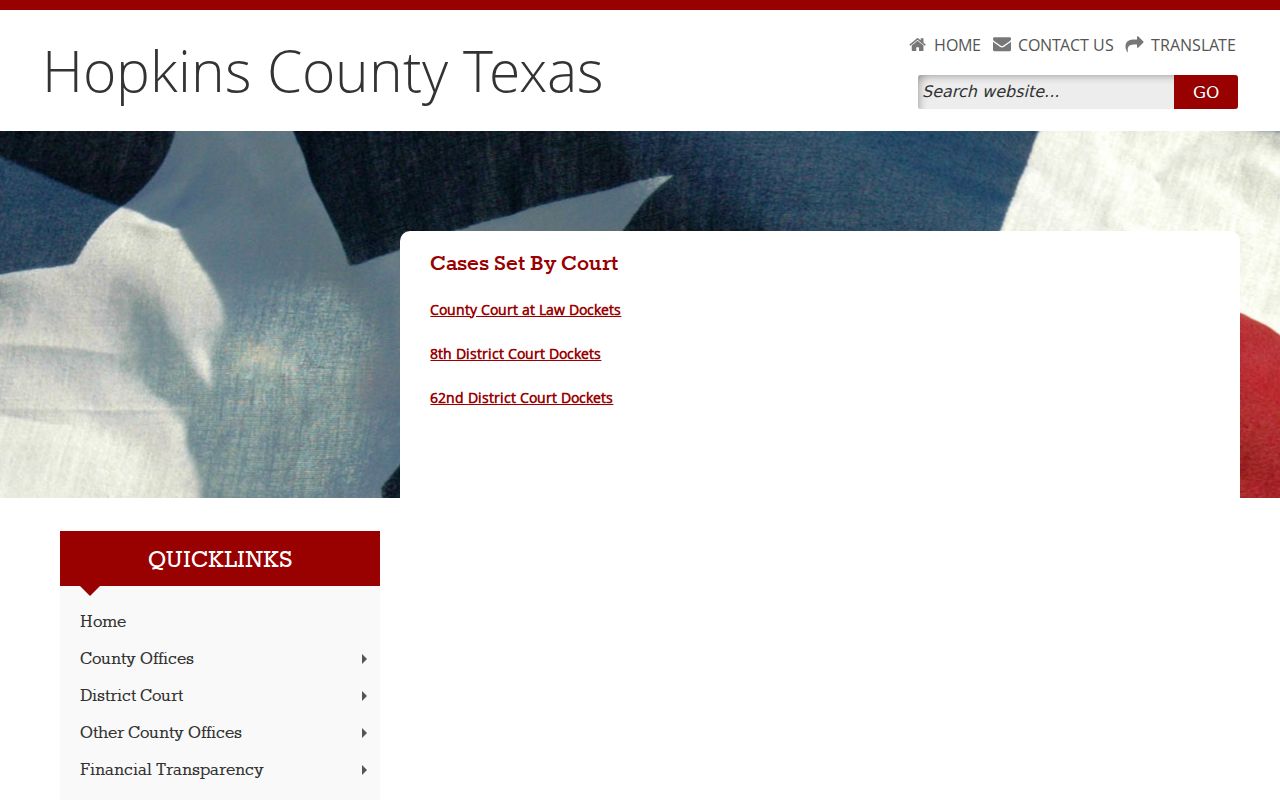
That official page presents three separate court choices. It shows no criminal case result, and a link listed there is no proof the portal behind it is working today.
| Case level | First court route | Record contact |
|---|---|---|
| Felony | 8th or 62nd District Court | Hopkins County District Clerk |
| Misdemeanor | County Court at Law | Confirm District Clerk or County Clerk custody |
| Class C | Justice or municipal court | The court that filed the matter |
Inside a Hopkins County Criminal Docket
A criminal docket is a running, dated account of court activity. Expect to find the court, a cause number, the case caption, an initiating charge, counsel, settings, motions, orders, plea or trial events, and disposition. What the public actually sees depends on the court and the system serving it. Since the Hopkins Easydocs views cannot be counted on to load, treat these as items to request or verify rather than fields guaranteed to appear online.
| Court and cause number | Identifies the court lane and stable file reference. No local number pattern was verified. |
|---|---|
| Charge | States an allegation or classification, not a finding of guilt. |
| Setting | May show arraignment, pretrial, plea, trial, or sentencing activity. |
| Motion and order | A motion asks for action; a signed order records what the court directed. |
| Disposition | Shows status or outcome, which should be checked against the judgment. |
| Access status | May explain why a document is redacted, restricted, sealed, or unavailable. |
One caution. A docket line is a summary, not the document itself, so when legal effect matters, ask the clerk for the signed judgment or order and whether a plain or certified copy is required.
Hopkins Criminal Docket Statewide Gap
Texas re:SearchTX offers search layers for cases, filings, text, and hearings. Its official guide walks through filters, detail views, exports, and saved searches. But the Texas Judicial Council materials list an exception. Criminal case records fall outside the current statewide collection. So a missing Hopkins County criminal docket there proves nothing.
Best fallback: Start at the county court-specific link, then call or visit the clerk that serves that court. Give the cause number, court name, case style if known, and date range.
Online access shifts without warning. An integration or outage can change what loads. Note which court and which source you checked, because that detail lets clerk staff tell a portal problem apart from a sealed record, a filing delay, or a case held by another office.
How a Criminal Case Moves
The first entry on a criminal docket is often the initiating instrument. That may be a complaint, information, or indictment. Arraignment comes next, covering the charge, rights, and plea process. Pretrial settings then track motions, discovery disputes, plea talks, or trial preparation. A later entry may record a plea or trial, followed by disposition and sentencing activity. Exact labels vary from court to court.
Docket flow: Charge Filed › Arraignment › Pretrial › Plea or Trial › Disposition › Sentencing
Pay attention to the order of entries. "Filed" only means the clerk accepted an item into the case file. It does not mean the judge granted it. A reset likewise moves a hearing date without dismissing anything. Read the next order or disposition before drawing any conclusion.
Note: Confirm any outcome with the signed judgment, since a short docket summary is not a certified court decision.
Hopkins Criminal Docket Pretrial Clue
A County Court at Law waiver procedure dated 2023 sets the pretrial docket. It lands on Thursday at 9:00 a.m. Under that procedure, the defendant signs the reset form. Counsel then e-files both the reset form and a Motion to Waive Arraignment. Motions are due before court day. It is solid evidence of how the court's workflow ran at the time. It is not a promise about today's schedule.
For present contact and scheduling instructions, the current County Court at Law page controls. It links criminal reset resources and sends scheduling questions to the court office. Confirm the active date and current form before relying on the older procedure.
Courts That Hold Criminal Dockets
Hopkins County splits its criminal dockets across several courts. The 8th and 62nd Judicial District Courts take the district-level work. That includes the felony cases assigned to them. Misdemeanors go to the County Court at Law, which sits inside a broader local jurisdiction. Below that, justice courts and municipal courts keep their own files. Each holds its own Class C files and citation records. The pieces connect, but they do not form one unified Hopkins County criminal docket.
So begin with the offense level and the court named on whatever paper you have: a notice, bond, citation, or earlier filing. Missing details? The District Clerk can check the district lane for you. The County Court at Law can explain its own records process. So can the right lower court. Staff will help with access and routing, though they cannot hand out legal advice.
Hopkins Criminal Docket Clerk Desk
For district criminal files, the Hopkins County District Clerk is the main local contact. Visit the office at 282 Rosemont Street, Suite 2, in Sulphur Springs, Texas. You can also call (903) 438-4081. Email works too, at dclerk@hopkinscountytx.org. The official page also lists criminal staff lines at (903) 438-4086 and (903) 438-4084.
District Clerk Criminal Records
282 Rosemont Street, Suite 2
Sulphur Springs, TX
(903) 438-4081
dclerk@hopkinscountytx.org
A County Court at Law misdemeanor works differently. Reach the court at 118 Church Street or (903) 438-4004, and ask whether the District Clerk or the County Clerk holds the item you want. Then request it by name: a docket lookup, a hearing confirmation, a particular filing, or a certified copy.
Hopkins Criminal Docket Events Differ
A charge only starts the court process. It is not a judgment. A motion is simply one party asking; an order is the court directing something. A setting puts an event on the calendar. A disposition records a status or outcome. Holding these terms apart keeps a preliminary entry from being read as a final result.
- Arraignment
- A proceeding that addresses the charge, rights, and plea procedure.
- Pretrial
- A stage before a plea or trial, often used for motions and case management.
- Reset
- A change to a setting. It does not by itself end the case.
- Disposition
- An outcome or status entry that should be matched to the official judgment.
- Certified copy
- A reproduction certified by the record custodian for an official use.
Once you know which court holds the file, a fuller search by name or cause number is available through the Hopkins County case lookup.
Sealed Dockets and Public Access
Texas does not treat court records like ordinary county agency files. Under Texas Government Code section 552.0035, access to judiciary records is governed by Supreme Court rules or other law. Rule 12 covers judicial records other than case records. Criminal case files also sit under court rules, statutes, sealing orders, redaction, and clerk procedures.
Two more layers matter here. Texas Family Code Chapter 58 shields juvenile records from public view. Expunction under Chapter 55A of the Texas Code of Criminal Procedure is its own legal process. It can remove records or restrict access. A missing result, in short, is never proof that no record exists.
Key rules:
Texas judicial open-records policy explains the Rule 12 and judiciary framework.
Texas Family Code Chapter 58 protects covered juvenile records.
Texas Code of Criminal Procedure Chapter 55A governs expunction.
If a clerk denies or limits access, ask which rule, statute, protective order, or sealing order applies. Never try to work around an access control.